In my first semester of grad school, I made an appointment with my advisor to talk through a problem I was having with an assignment. I was stuck, I told her, because in order to move forward in the paper I was trying to write, I’d have to assert my own opinion, something that had been explicitly forbidden in my undergraduate work. She looked at me kindly and said, “Jamaica. You are supposed to assert your own positions in grad school. Just make sure you defend them.”
Developing, communicating and defending your positions is indeed largely what assignments in grad school are all about and yet, if like me, you come into grad school not knowing what is expected of you, knowing how to approach assignments can be bewildering at best. The purpose of this page is to provide you with resources to support you in approaching some of the most common types of assignments you’ll encounter in your MLIS journey: papers, literature reviews and posters.
Academic Papers
An academic paper written at the graduate level is expected to meet multiple standards. First, and perhaps most obviously, it is expected to respond to some selection of previously existing scholarly literature, synthesizing information and perspectives drawn from course materials and/or external resources to offer a reasoned analysis of them. Second, graduate level writing is expected to be presented in a “scholarly voice,” in manner that conforms to predetermined style guidelines and supported by citations to external sources.1
Meeting these criteria requires a familiarity with one’s field, which is something that of course develops over time. If you are new to graduate school or to your MLIS program, you might feel a bit disoriented as you are asked to produce work that is in line with disciplinary standards you don’t yet fully understand. As you adjust, you might find the following resources helpful:
- Quick Reference Guide to Graduate-Level Writing. This is a resource that I originally put together as a Teaching Assistant for a core course in the MLIS program offered at the University of Pittsburgh School of Computing and Information.
- Graduate-Level Writing Tips from Purdue University Online
- Graduate Writing Overview from the Purdue University Online Writing Lab – An excellent and more comprehensive introduction, offering video explorations of graduate writing as a conversation, a process, a social endeavor and a disciplinary undertaking./
Literature Reviews
Literature reviews are a unique breed of written assignment. Looking much like a standard academic paper, their purpose is more precise: the point of a literature review is to succinctly present the discourse on a given subject not perfunctorily but rather with analysis, synthesis and critical thinking, placing works in conversation with one another so that, in sum, you and your reader gain a stronger understanding of what the literature has to say on the matter.
I put “the literature” and “the discourse” in italics above to draw attention to them, as you will hear reference to the literature, the discourse and the scholarship all the way through your MLIS (and other) graduate adventures. These are each a shorthand reference nodding to the body of works that together comprise the existing academic conversation on a subject. As an incoming MLIS (or other graduate) student, you are expected to begin to engage with the literature/discourse/scholarship of your field. A literature review is an excellent means of doing so, as it will not only expose you to what’s been discussed previously, but it will also introduce you to debates across the field as well as to the practice of critically considering your sources.
The act of completing a literature review is often described in steps – the most common of which I detail, with supporting sources, below. It is important to recognize, however, that the actual experience of completing a literature review is almost always iterative. Reviewing an initial set of sources will lead you to redefining your scope, which will lead to a new search for resources, which will themselves inform your categorization, which will inform your synthesis, and so on. You are not doing it wrong if your process is a loop rather than a line. Remain open to learning and revising as you go along, and remember that while your sources are written by other people, it is your synthesis and insight that will help to identify the meaning among them.
Standard Steps of a Literature Review
- Identify Your Subject and Scope: This will involve carefully reading your assignment clarifying any necessary points with your professor and selecting a scope that meets not only the requirements of the assignment but is feasible within the time you have available.
- Select Your Sources: This can and often does begin with a search of your library database. Your course’s syllabus and reading list is also an excellent point from which to start. Identify one or two sources, read them, and then turn towards their bibliographies to find additional promising sources. Do the same with those and onward. Above all others, this might be your most iterative step so keep going until you gain some sense that your selections comprise a good representation of your subject and fit well within your scope.
- It is very important when selecting sources that you evaluate them for credibility and currency. “Credibility” here means that they are drawn from reputable sources that are relevant to your disciplinary community. “Currency”, meanwhile, suggests the timeliness of your sources. Definitely do include articles from 1912 if they are canonical and essential to a thorough review of the subject. Definitely do also try to avoid sources that might, regardless of date, be irrelevant or obsolete.
- This stage provides an excellent opportunity to familiarize yourself with citation management software. Most citation management solutions will not only help you organize and format your citations, but will also help you annotate pdfs and draft summaries of them all in one place.
- Summarize Your Sources: Write a brief summary of each of your sources. These summaries will not form the body of your literature review but they will inform it, and they will also help you to organize your thoughts and prepare for synthesis (your next step). When summarizing each work, write briefly on the methodology, findings and conclusions of the study (if it is indeed a study that’s being discussed). Include a synopsis of the authors’ positions and arguments, summarize their main points, and take note of any areas of agreement or disagreement with other others.
- It is essential when summarizing the work of others that you restate what they’ve done and said in your own words. This helps you to synthesize their work into your own understanding and helps you avoid plagiarism. Here is a helpful overview of how to avoid plagiarism when paraphrasing others’ work.
- Synthesize Your Sources: You’ll recall that a key function of a literature review is to synthesize prior scholarship on a given subject. To do this, you will need to carefully consider your sources in terms of their driving points, their points of agreement, their points of disagreement and (depending on your focus) how they represent a change in the discourse over time. A synthesis matrix, such as this one provided by North Carolina State University Libraries, can be a great help.
- Write Your Literature Review: Working from both your summaries and your synthesis, write a narrative that explains the conversation you observed across your selected sources. This can take many forms such as chronological, thematic, and likewise. Be sure to write in your own voice, use quotes sparingly, cite your sources and review with your university writing center to avoid plagiarism.
- Additional Resources: The following sources helped to inform this guide, and will be great supports for you as you plan, organize and write your literature review.
- North Carolina State University Libraries Literature Reviews – An Overview for Graduate Students: A 9.5-minute video (with transcript) providing an excellent introduction.
- Purdue University Online Writing Lab – Writing a Literature Review: Addresses the when, why, where and how of literature reviews, including clear guidance on how to organize your writing.
- Johns Hopkins Sheridan Libraries – Write a Literature Review: By following the blue stacked menu on the left-hand side, you will find your way to invaluable resources, such as this Lit Review Prep workbook.
- James Madison University – Sample Literature Review: This links directly to a PDF of a well-notated example of a literature review done by a student as part of their graduate coursework.
Posters
Of all assignment types that seems to baffle incoming students, I have observed that academic posters tend to confuse more often than any other. This is understandable, given how easily they might be taken as elementary or crafty. Posters are in fact an integral component of scientific and scholarly communication, afforded their own sections (and ballrooms!) at academic conferences and playing key roles in the development of research projects.
In academic and scientific circles, posters are often used to present preliminary findings. Graphs and charts are supplemented with limited, essential text to introduce these findings for discussion and feedback. Posters are presented in dedicated conference sessions during which conference attendees mill about, reviewing the posters and asking questions of the presenters.
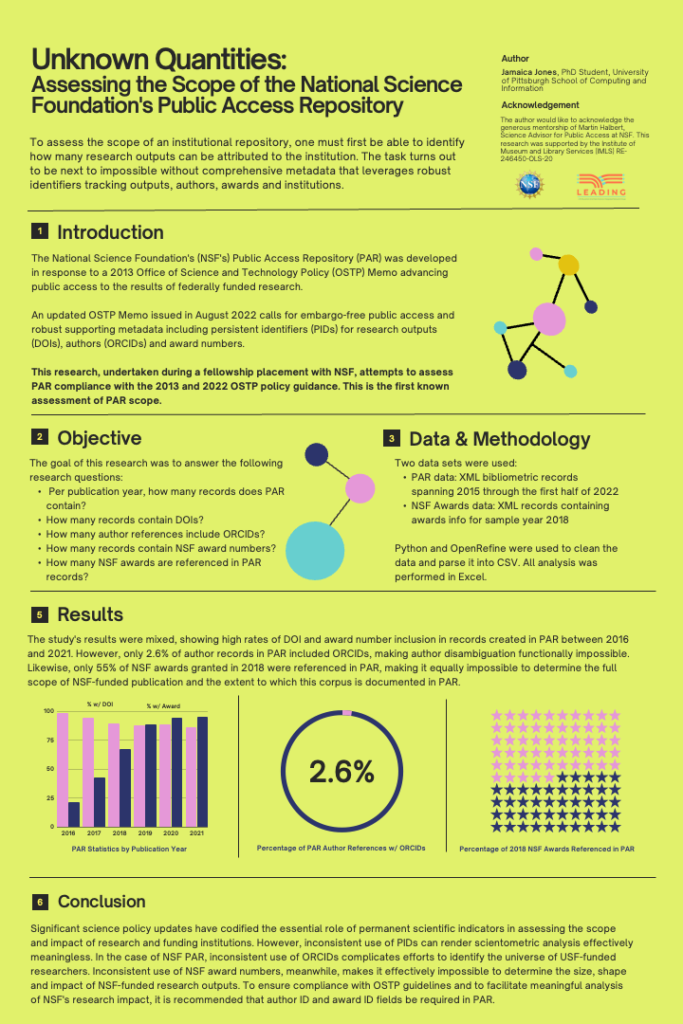
As an MLIS student, you will likely be asked to produce a poster or two as part of your coursework. You will likely not have completed a traditional research project and therefore probably won’t be able to organize your poster according to the standard sections (see the example below). Never fear! Posters can be adapted to present research of all kinds. So long as you meet the guidelines outlined below, you will have created an effective, engaging academic poster.
Poster Guidelines
- “Highlight the main point so that it can be read and understood from a distance”. This key piece of advice is your most essential guidepost, provided by an excellent Yale University Library Lib Guide.
- Think of your poster as an extended abstract – a summary of your research, designed to convey nothing more than the most important takeaways, supported by meaningful graphics. “Less is more” is a common phrase used when talking about academic poster design. A good rule of thumb is to limit your text to about 100 words per section.2
- Use design software that is comfortable for you. Not everyone is a PhotoShop wiz, and not everyone needs to be! PowerPoint is an excellent tool for creating academic posters. Canva might even have PowerPoint beat, though. Supporting easily-created graphs and providing an endless supply of licensed graphics, it has everything you need to create a fresh, modern poster.
- The standard size for an academic poster is generally 48″ by 36″, in either orientation. Clarify size expectations with your professor before getting started (reformatting everything to size is a drag).
- Follow basic design principles to present information in a way that is both effective and eye-catching. If you scroll to the bottom of this page, you will find a nice assortment of resources supporting good design. Graphic design platforms such as Canva incorporate good design principles and color theory into their resources, so those of us who are not artistically inclined (I am definitely included here) don’t have to reinvent a wheel.
Poster Resources
- The Purdue University Online Writing Lab Research Poster Overview, a quintessential starting point and comprehensive guide.
- A ~4-min video introduction to academic posters by AJE Journal Experts
- How to Design a Research Poster by University of Missouri Undergraduate Research
- A guide to creating posters with PowerPoint by University of York
1Davenport, Debra. “Graduate-Level Writing Tips: Definitions, Do’s And Don’ts.” Purdue University Online. Accessed September 20, 2023. https://online.purdue.edu/blog/graduate-level-writing-tips.
2Gundogan, Buket, Kiron Koshy, Langhit Kurar, and Katharine Whitehurst. “How to Make an Academic Poster.” Annals of Medicine and Surgery 11 (September 6, 2016): 69–71. https://doi.org/10.1016/j.amsu.2016.09.001.